

Tasting Notes and Scores
Heady and burgundian. Subtle and very hedonistic. Lots of fruit and spice and the tannins are not dominant in fact. Very dense and more masculine than most Moulines. They creep up on you! The driest Mouline I can remember. Spicy with strong liquorice notes – very firm. Chewy wine. Marcel’s deeply politically incorrect comment on this wine: ‘There are wines that are wives and wines that are mistresses. This is serious not charming.’ (So – this is a wife then: ‘on peut conter sur lui.’) Seems almost ready when tasted after Landonne 2005! (JR)
Jancis Robinson
Jancis Robinson
2009-10-26
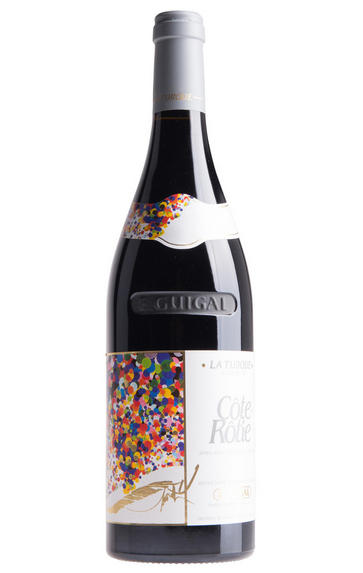
Another ridiculous effort, the 2005 Cote Rotie la Mouline doesn’t pull any punches and is perfectly balanced, deeply concentrated and shockingly rich, with a seamless, elegant and silky character that’s to die for. Giving up notions of smoked beef, iron, spring flowers and thrilling black raspberry and blackberry fruit, this classic La Mouline has nothing out of place, beautiful purity and precision, and incredible length. More in the style of the 2010, it can be consumed anytime over the coming 2-3 decades. Drink 2014-2044.
100 points – Jeb Dunnuck (eRobertParker.com, Aug 2014)
Similar to the powerful 1988, the inky/purple-colored, dense 2005 Cote Rotie La Mouline offers a stunning perfume of espresso roast, licorice, pepper, blackberries, and black cherries intermixed with hints of chocolate and spring flowers. Powerful, super-concentrated, and ruggedly-constructed with a boatload of tannin, this is a wine to forget for 4-5 years, and drink over the following 25-30. It is the densest, most tannic vintage of La Mouline since 1988. Drink 2013-2043.
100 points – Robert Parker (Wine Advocate, April 2009)
Wine Advocate
Another ridiculous effort, the 2005 Cote Rotie la Mouline doesn’t pull any punches and is perfectly balanced, deeply concentrated and shockingly rich, with a seamless, elegant and silky character that’s to die for. Giving up notions of smoked beef, iron, spring flowers and thrilling black raspberry and blackberry fruit, this classic La Mouline has nothing out of place, beautiful purity and precision, and incredible length. More in the style of the 2010, it can be consumed anytime over the coming 2-3 decades. One of the reference point estates for top quality wines in the world today, the family run Guigal operation was created in 1946 by Etienne Guigal. Today, Etienne’s son, Marcel, and his son Philippe, are firmly in control here, and are without a doubt producing some of the most singular, sought after wines in the world. Due to the size of this tasting, I’ll keep my comments short, but the incredible quality coming from this operation is astounding, and a tasting here is always one of the highlights of any trip through the region. Furthermore, while a lot is said about the extended oak aging regime here, I don’t know anyone who tastes mature examples of these wines on a regular basis that still has any doubts about the genius going on here. In short, these single vineyard (and their blends as well) Cote Roties are some of the greatest wines money can buy. For this tasting (which, with the Guigals, is always a large one!), we focused on their Saint Joseph Vignes des Hospice release, and then three of their Cote Roties, starting with the classic Brune et Blonde, then the Chateau d’Ampuis, and finishing with their single vineyard La Mouline. Looking first at their Saint Joseph Vignes des Hospices release, it comes all from the incredibly steep (and picturesque) vineyard perched just above the town of Tournon. The exposure here (which is critical for Saint Joseph as the more southern facing the plot, the warmer the site is) is mostly east facing and the soils are pure granite (identical to the decomposed granite found in the Les Bessards lieu-dit on Hermitage Hills). Compared to the Saint Joseph lieu-dit, which has a slightly more southern exposure, harvest here is always 5-7 days later. Moving north to Côte Rôtie, the Guigal’s Brune et Blonde is their entry level release that comes from a mix of vineyards, most of which are estate. It drinks beautifully on release and has a solid 15-20 years of longevity in top vintages. Stepping up over the Brune et Blonde, the Cote Rotie Chateau d’Ampuis is named after the Chateau d’Ampuis estate (which lies in the town of Ampuis, right up along the Rhone River, and was purchased by the Guigal’s in 1995) and is a blend of their top estate vineyards. Coming from La Garde, Le Clos, Grande-Plantee, Pommiere, Pavillon, Le Moulin and La Viria, it spends close to four years in new French oak (handled just like the single vineyard releases) and there’s roughly 30,000 bottles produced in each vintage. While the single vineyard releases get all the buzz, this is isn’t far behind in quality, especially in recent vintages, and can represent an incredible value. We finished the tasting with a vertical of La Mouline. One of the three single vineyard Cote Roties produced, this cuvee comes all from the La Mouline lieu-dit that’s located in the more western (close to the middle actually) side of appellation. For simplicities sake, you could say it’s in the Cote Blonde part of the region, but in reality, Cote Rotie is much more complex and diverse. Due to its exposure, this vineyard is always the first of the three single vineyards to be harvest, and also contains some of the oldest vines on the estate. Fermented using pump overs (as opposed to punch downs for the La Torque and submersion cap on the La Landonne), it’s cofermented with varying degrees of Viognier, which in most vintages, ends up being around 10% of the blend. Like the Chateau d’Ampuis and the other two single vineyard releases, it sees close to four years in 100% new French oak, of which every trace integrates after a few years in bottle. It’s always the most approachable of the single vineyard releases, and is ready to drink at an earlier stage. For example, the 1999 La Mouline is gloriously mature, while the 1989 La Torque is still an infant. Nevertheless, as the 1978 reviewed here attests to, it has no problem evolving for decades (although I don’t recommend holding bottles that long). In short, this was a flight of Côte Rôties I’ll not forget anytime soon! Importer: Vintus Wines, Pleasantville, NY; tel. (914) 769-3000
Jeb Dunnuck
Wine Advocate
2014-08-28

Rhone
View loose bottle(s) available.

Rhone
View 3 pack case(s) available.
Rhone
View 6 pack case(s) available.
Rhone
View 3/6 pack case(s) available.

Pricing includes duty and VAT.
Want To
get In TouchPlease contact the LiveTrade team today for more information or to book a demo.
Contact us